About my research, for mathematicians
Note: the following contains simplifications of the truth, and some of the statements are not technically correct or not as general as they could be.
I want to describe one thread that motivates a lot of my research. It doesn't cover everything, but it's a big motivating factor.
The combinatorics of motives
Grothendieck's idea of "motives" is a major motivating factor for modern algebraic and analytic geometry. Let's exposit the basic idea. The concept of linearity is a recurring theme in mathemtics, and lesson of this theme is that linear objects are much easier to deal with than nonlinear objects. In geometry, this philosophy comes up in the study of (co)homology theories. Given a category of "geometric spaces" (for example varieties, manifolds, etc.), one associates a "linear" object to a geometric space . One can then use properties of the linear spaces to prove various facts about X. In categorical language, is a functor from geoemtric spaces to linear spaces.
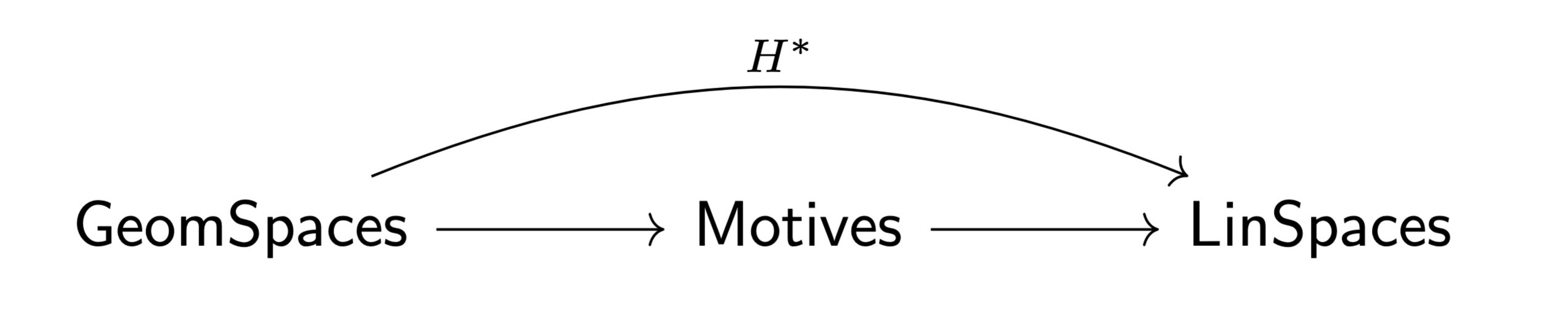
However, there isn't just one cohomology theory, there are many different ones, each with the same nice properties. However, there are no-go theorems (for example, the one due to Serre) which guarentee that a universal cohomology theory cannot exist. There are various setting one can work in, but perhaps the most famous is characteristic algebraic geometry, for a fixed prime number. Here, we have -adic cohomology (for a prime different than ) and various flavors of -adic cohomology (rigid, crystalline, and so on), and Serre's no-go theorem saying that they can't come from some cohomology theory over .
Grothendieck's philosophy is that despite the no-go theorem, there should be some sort of category, called the cateogry of motives, that acts as a universal cohomology theory. So we'd expect any nice cohomology functor to factor through a functor from geometric spaces to motives.
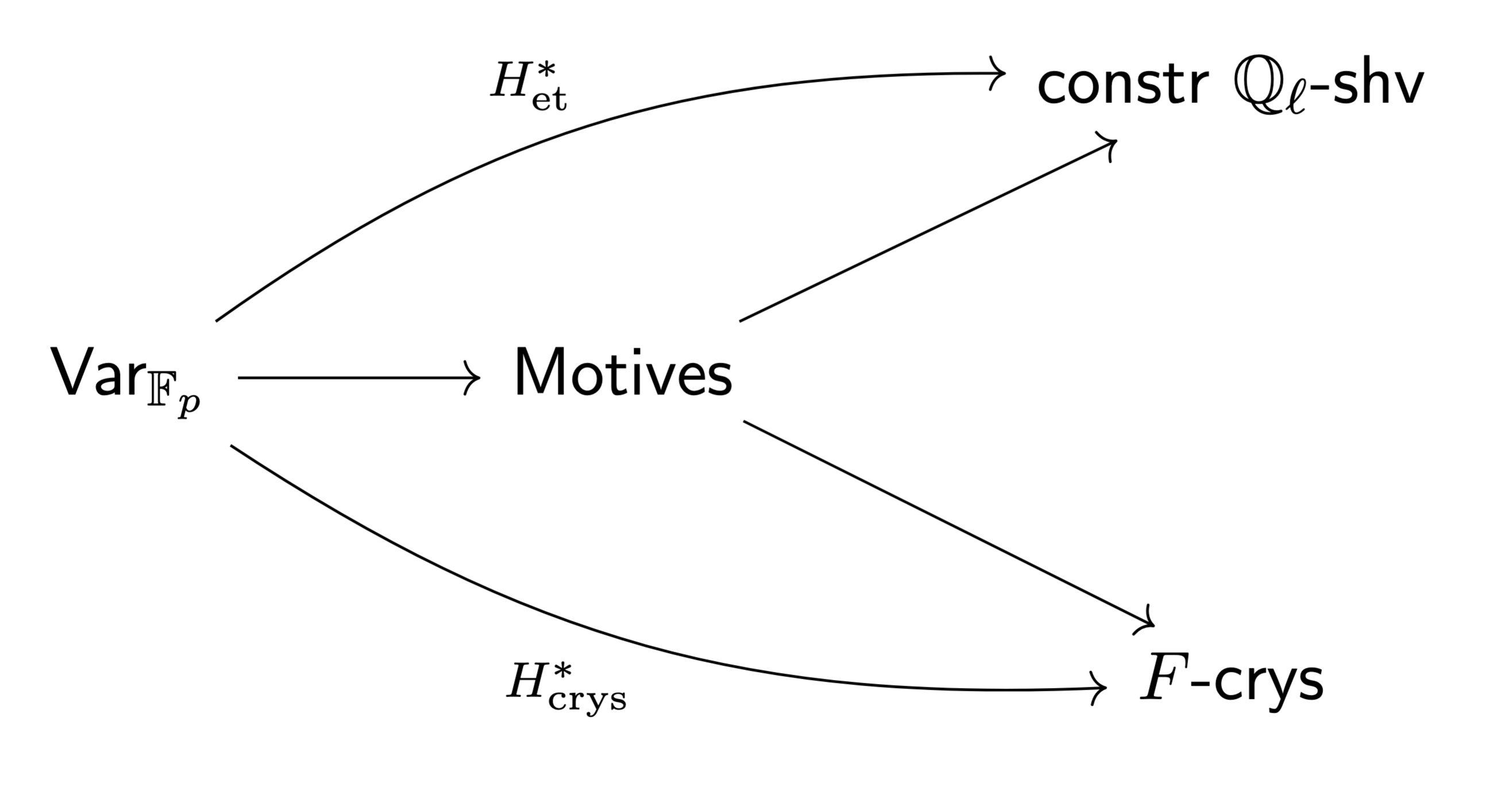
Now, making a definition that *should* coincide with the correct category of motives isn't completely impossible. Grothendieck even did this for "nice" spaces with his category of pure motives. However, the definition of pure motives is really abstract, and it's quite hard to prove things with it. What's missing is a combinatorics for this category, i.e. a concrete way to work tangibly with the objects and morphisms in the category.
On the other hand, given any particular cohomology theory (e.g. crystalline), one often has a natural extra structure on this cohomology (e.g. an -crystal). Such objects tend to be pretty useful for computations and can be used to prove concrete facts about algebraic varieties. That is to say, their combinatorics is well-understood. However, they might not contain enough information to prove harder facts, because they don't know anything about the other cohomology theories. For example, -crystal structures on crystalline cohomology don't know about étale cohomology.
So that's the duality of motives. We can either define something "close to the motive" which will be abstract, or we can define something "close to the ground" that might not contain enough information to prove the fact that we want. Research tends to reflect this: either we start with an abstract definition and work really hard to understand anything at all about it, or we start with a concrete definition and try to prove that the information it contains is already enough for our purposes.
There are many research topics in algebraic geometry that are some variant of this philosophy: we define some notion which should be related to motives. Usually it's a numerical invariant that should be deducible from knowledge of the motive, perhaps a linear category that should recieve a functor from the category of motives, or even a definition that should recover the correct notion of motives if we had a combinatorics for it. This includes, but is not limited to *deep breath* motivic homotopy theory, motivic cohomology, -theory, Chow motives, pure motives, mixed motives, mixed Tate motives, Chow rings, algebraic cycles, Hodge structures, mixed Hodge modules, log canonical thresholds, Bernstien-Sato polynomials, domino numbers, Gromov-Witten invariants, Hodge atoms, -crystals, constructible sheaves, -gauges, prismatic -gauges, prismatic -crystals, -pure thresholds, quasi--pure thresholds, Dieudonné modules, -divisible groups, Tate modules, Newton polygons, Ekedahl-Oort types, -ranks, -numbers, Sato-Tate groups, motivic Galois groups, Galois representations, modules with integrable connection, and so on and so forth. With this broad interpretation, one can say that perhaps a majority of algebraic geometers are studying motives!
My interest in motives is in exploring this combinatorics: considering various notions like the ones written above, calculating them (often on a computer), and trying to find patterns and relationships, in the hopes that one day maybe this will shed some light on the deeper story. Abstractly, I'm interested in any of the things listed above and probably more, but of course I am a finite human being and have expertise in very few of them.
There has been some exciting recent progress in this area. The paper arXiv:1802.03261, colloquially known as "B-M-S Two", constructs a "motivic filtration" (something that was discovered from a "close to the motive" approach due to Voevodsky et. al.) on -adic algebraic -theory using a cohomology theory that is "closer to the ground". The cohomology theory in question is a variant of crystalline cohomology, called prismatic cohomology, though the paper predates that term. Prismatic cohomology has recieved a lot of fanfare, and the philosophy of motives shows why: it seems to be honestly closer to the motive than things that we've dealt with before, and it's also likely to be sufficiently computable to actually do stuff.
One major thread of my current research is to actually compute prismatic cohomology and various downstream invariants (though so far, I have only gotten to the char= case which is equivalent to crystalline cohomology) and investigate the combinatorics and patterns arising from these invariants. For example
arXiv:2502.12428 gives algorihtms and implementations to compute one such donwstream invariant (the "quasi--split height") about 1000x faster than previous implementations. The methods should apply to other downstream invariants, and I hope to explore this in future work.
arXiv:2509.06211 shows that there exists a relationship between two downstream invariants (the "quasi--split height" and the "-pure threshold"). The previous proof uses cohomology heavy machinery, but our proof is "close to the ground", very short, and more general. Is this evidence of something deeper going on at the cohomology level? Is it an artifact of the setup we have? It's unclear, but I'd be really interested to find out.
arXiv:2602.24155 gives improved algorithms, data structures, and implementations for calculating the -crystal structure on crystalline cohomology. It includes faster versions of cases where implementations did exist before, and also cases where computations did not exist before. We also find new examples of things which various downstream invariants which weren't known to exist before, including examples of new Newton polygons, -ranks, domino numbers, etc.
For more on my research, see my papers. For another thread that motivates some of my other research, see my description for non-mathematicians